Often the quality of life is already quite limited by the time we start pondering the question whether or not we are suffering from burnout. Those affected are often unsure what exactly ‘the problem’ could be. Questions arise such as: ‘Is it something physical, or am I simply under a lot of stress and not getting enough rest?’ And, of course, the question ‘What can I do about it?’
Burnout and depression: differences and similarities
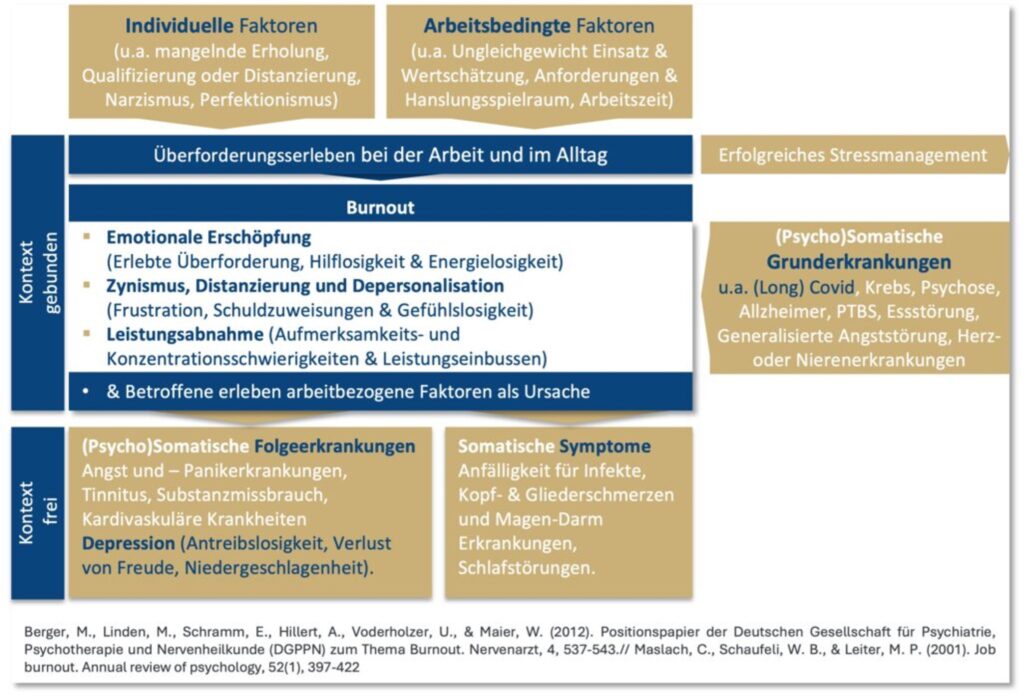
The WHO generally classifies burnout as a syndrome rather than an illness due to its various causes and symptoms, which make it impossible to clearly define and distinguish it. Depression, on the other hand, is a diagnosable mental illness with defined primary and secondary symptoms and clear distinctions from other illnesses. The difference is relevant, among other things, for the reimbursement of costs by health insurance companies, which is not the case with burnout.
The most striking distinguishing feature in diagnostics is the reference to workplace and job conditions, which is at the forefront of burnout. This is relevant for the diagnosis, the course of the illness and the treatment.
Progression: Burnout usually progresses in successive phases. It is often triggered by a phase in which those affected expend excessive energy. If this state persists, is driven by fears (e.g. not achieving a goal on time or to the desired standard) and is not recognised, feelings of frustration, aversion and futility can arise. We describe the phases in detail here. Depression, on the other hand, can develop similarly gradually, but can also occur suddenly and is more strongly associated with critical life events, hormonal changes and pessimistic (vs. perfectionist) attitudes.
Treatment: In cases of burnout, coaching (e.g. setting boundaries, sharpening personal purpose, promoting a balanced lifestyle) is the main focus. A depression is usually treated with outpatient or inpatient psychotherapy and, depending on its severity, with psychotropic drugs. The first point of contact is the family doctor, who refers the patient to a specialist in psychiatry.
While rest, sleep and holidays have a positive effect on burnout symptoms, these regenerative activities can exacerbate depressive symptoms.
A hospital stay for burnout may be relevant in the following cases:
- severe and persistent symptoms,
- additional symptoms of illness,
- Increase in depressive symptoms,
- suicidal thoughts,
- when a break from the social context seems essential.
Long Covid has various symptoms that overlap with burnout and depression, with chronic fatigue being the main symptom. Mental and physical activity is hardly possible, and while physical activity leads to improvement in cases of depression and burnout, in this case it leads to a worsening of symptoms. People with long Covid often experience overlapping symptoms of depression and burnout. Current research locates the cause of this more strongly on a physical level than in the case of other diagnoses.
First steps towards greater clarity
The ‘island’ self-test
Imagine you are on a desert island or relaxing in the fresh mountain air on a sunny meadow. All stressful circumstances are behind you, and your to-do list is empty. Can you feel relaxation and imagine enjoying this moment?
While people with depression experience joylessness and meaninglessness in all areas of life, those affected by burnout tend to feel joy again when they are relieved. Travelling (even in your imagination) often exacerbates the symptoms of depression, whereas with burnout, distance and ‘getting away’ can bring relief.
Our support services for you
Do you recognise any of these symptoms? Are you unsure how to assess your current condition? Do you have any further questions?
In a free initial consultation, we will get an idea of your symptoms and your current situation. We use our psychological expertise and many years of experience to work together to create clarity. The next steps will also be discussed here, which will help you improve your quality of life and regain more inner balance. In doing so, we always keep your everyday management challenges in mind. We look forward to hearing from you.
Sources
More on this topic can be found in the book “Bernhardt, K. (2019). Getting rid of depression and burnout: How mental lows really arise, and what you can do about them. Ariston.“