


Transformation

Cultural development

Cultural development

Real change begins in the minds and hearts of your employees.

Let us explore new ways together to convince the mind and win hearts. We offer you cultural development that has an impact from the inside out and ensures lasting success.

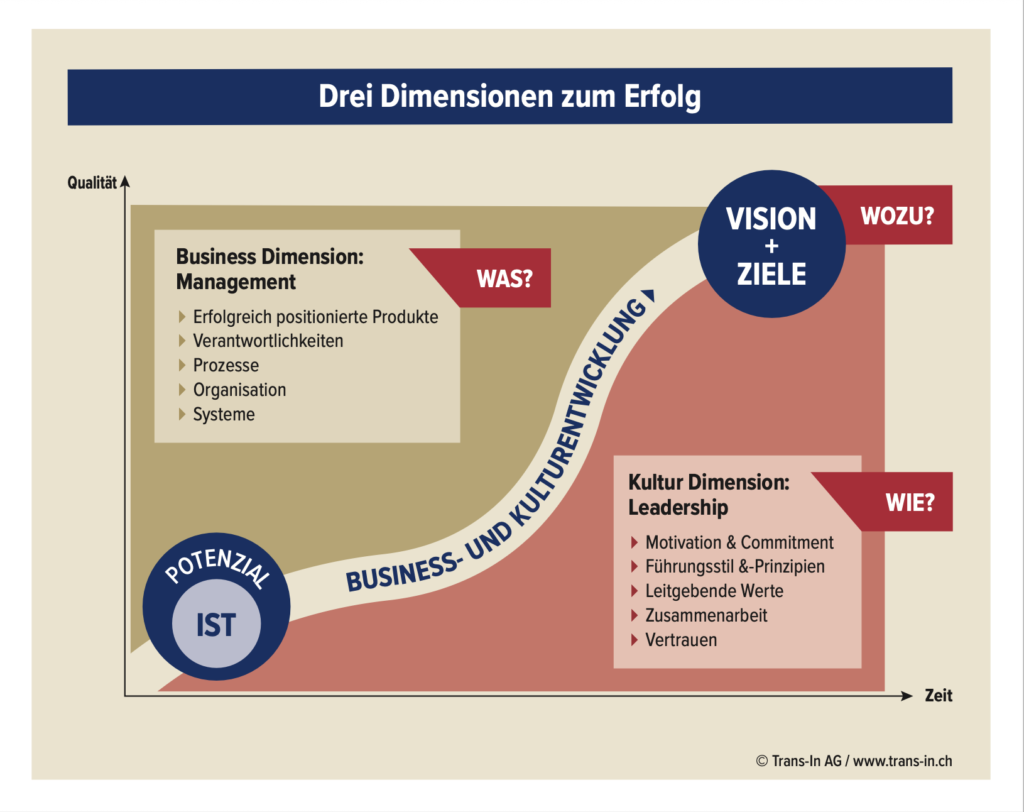
Why is cultural development necessary?

Ask yourself the following questions:

  • What is our company here for?
  • What makes us unique?
  • Where do we want to be in 5 years’ time?
  • How do we want to get there – and how not?
  • What mindset and skills do our managers and employees need for a sustainable organization?

Cultural transformation – Our offer

  • Mission statement and vision development for joint alignment
  • Sharpening values for clear dos and don’ts in everyday life
  • Identifying and systematically strengthening potential in cooperation
  • Impulses for a contemporary understanding of leadership
  • Targeted development of leadership skills with a focus on personal responsibility, communication and empowerment
  • Change processes that are participatory, profound and long-term

Possible occasions for cultural development

Strategic realignment

Business models, markets and structures are changing.

New leadership

Values, cooperation or leadership are to be updated.

Growth & Scaling

Companies grow and need a suitable structure and culture.

Increase in efficiency

Decision-making processes, procedures and cooperation are to be improved.

Change Management

Mergers, reorganisations or technological changes are imminent.

Conflicts & Blockages

Tensions between teams, management levels or departments hinder cooperation and progress. You may also be interested in: Team development.

Trans-In

The process of cultural development with Trans-In

We always tailor the content, scope and schedule to your company profile and your needs.

Joint assessment – Where do we stand?

Assessment of the current situation – current strengths, weaknesses and challenges – through semi-structured interviews with key individuals, use of focus groups and scientifically based instruments (e.g. surveys).

Determine procedures and areas of action – What is required?

Initial derivation of areas of action and development potential. Joint development of objectives, definition of milestones and setting up of the process. Tailored precisely to your needs and agile in its execution – always aligned with current issues, both internal and external.

Removing potential obstacles – What stands in the way?

Targeted resolution of potential legacy issues or future obstacles, such as hidden or open conflicts between parties or committees.

Developing a clear direction with traction – Where do we want to go and how?

Joint development of a mobilising vision with a selected group or the entire management team in a 1.5-day workshop. Sharpening corporate values and translating them into concrete behaviours in everyday life.

Enabling profound change – How do we implement our goals in everyday life?

Crisp impulses and profound development for a future-oriented mindset and relevant skills in workshop, coaching and short input formats (on-site & online) with selected target groups. Recognition of initial successes. Individual development potential can be unlocked through accompanying executive coaching.

Anchoring change for the long term – How do we ensure sustainability?

Training selected internal multipliers to take new employees on board in a self-directed manner. This enables long-term cultural change to be maintained and developed independently.
Contact

Take the first step now – take control of your company's future.

We look forward to discussing your needs and exploring how we can best support you. For visible and successful change.

The added value of cultural development with Trans-In

Our cultural development contributes to these results.
Photo Trans-In in cultural development

Eine Auswahl unserer Kunden & Kooperationen

Wüest&Partner Kundenlogo
Lindt&Sprüngli Kundenlogo
Ruggli Kundenlogo
ProSiebenSat.1 Media Kundenlogo
Allianz Kundenlogo
Kantonsspital Baselland Kundenlogo
FAQ

Frequently asked questions

Frequently asked questions about cultural development

A clear vision provides guidance and a common direction – it answers the question of where your company wants to go. Values are the guard rails along the way – they determine which attitudes and behaviors you promote in everyday life and which you do not.

Both are core elements of corporate culture: how people think, argue, decide, act and interact with each other in everyday life. Every company, every department, every team has a culture. The question is to what extent it corresponds to the desired behavior or to what extent the vision has become obsolete and been forgotten in everyday life.

One of the main goals of cultural development is to consciously shape corporate culture – as a catalyst for your corporate strategy and long-term success.

These are common obstacles to cultural development:

  • Lack of understanding: Even with an expensively developed vision and intensive communication, the message often remains unclear. There is a lack of early involvement in the process, relevance to everyday relevance and translation work.
  • All too human – fears: Change is frightening. It goes hand in hand with loss, with uncertainty for ourselves; we have to reposition ourselves, we may have had bad experiences, and the outcome is uncertain. As it often sounds to the outside world: ‘We’ve always done it this way,’ ‘It’s working fine as it is,’ ‘It won’t make any difference anyway.’
  • Insufficient skills: Even if the will is there, changing behavior is difficult. The brain loves to save energy and seek quick rewards – but new habits take time and perseverance. Willpower is limited and diminishes over the course of the day – especially after stressful days. In addition, old behavior patterns are emotionally anchored (‘I sleep better when I’ve got it done’), while new patterns are mostly purely rational (‘I should work less’). No wonder change is difficult – but not impossible.
  • Competing or corrupting values: What if the “new” somehow feels wrong? For example, personal striving for security and perfectionism can stand in the way of the desired agility and innovation.
  • Incongruence between desired culture and everyday corporate life: innovation and synergies should be embraced, but mistakes are punished and individual achievements rewarded.

These are the target groups of cultural development.

  • Entrepreneurs, executives or board members who want to make their companies fit for the future.
  • Management teams and decision-makers who seek guidance and clarity in change processes.
  • HR managers who support cultural and leadership development or change processes.
Zeit, Potenziale zu entfalten

Lassen Sie uns gemeinsam herausfinden, wie wir Sie optimal unterstützen können.

Kontaktieren Sie uns

Vereinbaren Sie jetzt Ihren unverbindlichen und kostenfreien Termin mit uns.

Wir freuen uns auf Sie.